Part 1: Should I use Corporal Punishment?
Introduction/Disclaimer
Note: I have prepred this document for MY OWN BENEFIT. If you agree or disagree with any of the points raised, then feel free to tell me. However don’t even pretend to think that I am telling YOU what to do. You can read, which means that you are capable of salient thought. Or in other words: make up your own mind.
I have tried to include all relevant supporting evidence, but if you think/feel I have missed something or misinterpreted something, then feel free to advise me (it doesn’t mean that I will change my mind).
All scripture references are taken from the King James Version, mostly because that is the version that I have on my computer with links to the Strongs Dictionary. I suggest that you read the verses in a version that you feel comfortable with.
I am the father of two wonderful children (this is a biased statement based purely on personal judgement) and it is my intention to raise them in the best manner possible. I believe that imperfect parents cannot raise perfect children; but I’m going to give it my best shot. Also, as a Christian, I would like to raise my children according to the principles given in the Bible (hence there will be a lot of scripture verses in here).
I was inspired to write/compile this information due to recent proposed legislation here in Poland. Esentially the government is intending to legislate that it is illegal for parents to use corporal punishment. We have discussed this with a number of people here in Poland, and they seem to suggest that Christians should ignore this law and raise their children according to what is written in the Bible. Therefore I have been presented with a decision: Either obey the law of the country, or obey what is contained in the Bible. But before I can decide which law I will obey, I must first discover for myself exactly what the Bible says about corporal punishment as a method for disciplining children.
What does the Bible say about discipline?
The following are pertinent scripture verses. I have shown the verse with my conclusions shown below each verse:
Proverbs 22:6
6 Train up a child in the way he should go: and when he is old, he will not depart from it.
(This verse suggests that a parent or guardian can have an impact on their childs life if they train their child. This is logical and makes sense)
Proverbs 3:11-12
11 ¶My son, despise not the chastening of the LORD; neither be weary of his correction:
12 For whom the LORD loveth he correcteth; even as a father the son in whom he delighteth.
(These verses liken the chastening of the LORD to the discipline that a father gives his child. No child likes discipline, but then neither do adults. These verses also suggest that you only discipline people that you love or are responsible for. Again this makes complete sense)
Proverbs 29:17
17 Correct thy son, and he shall give thee rest; yea, he shall give delight unto thy soul.
(An obedient child will definitely give a father rest)
Proverbs 19:18
18 Chasten thy son while there is hope, and let not thy soul spare for his crying.
(This verse suggests that chastening or discipline should start before the child starts developing wrong ideas or bad habits. Most discipline involves providing a negative outcome in response to a child’s negative action. This invariably causes tears even when no harm is done to the child)
It is quite clear from the above verses that the Bible suggests that if you discipline/chasten a child properly and lovingly, the child will grow up to be obedient and disciplined.
I note that however that most of the scriptures about discipline are in Proverbs, which is a book largely attributed to King Solomon. King Solomon was a wise and wealthy king of Israel, but he didn’t end his life as well as he could have (1 Kings 11). Maybe he should have listened to his own advice? Maybe when a child becomes an adult, they become responsible for their own decisions/actions?
How should I discipline my children?
Proverbs 13:24
24 He that spareth his rod hateth his son: but he that loveth him chasteneth him betimes.
Proverbs 22:15
15 Foolishness is bound in the heart of a child; but the rod of correction shall drive it far from him.
Proverbs 23:13-14
13 Withhold not correction from the child: for if thou beatest him with the rod, he shall not die.
14 Thou shalt beat him with the rod, and shalt deliver his soul from hell.
Proverbs 29:15
15 The rod and reproof give wisdom: but a child left to himself bringeth his mother to shame.
Well. That appears quite clear doesn’t it. But before I head off to the nearest supermarket to buy a rod, it might be a good idea to find out what it actually is.
The Hebrew word used here for rod is shebet:
(Strongs number 7626) shebet shay'-bet from an unused root probably meaning to branch off; a scion, i.e. (literally) a stick (for punishing, writing, fighting, ruling, walking, etc.) or (figuratively) a clan:--X correction, dart, rod, sceptre, staff, tribe.
Or in other words, a rod is literally a stick used for many things including punishing, writing, fighting, ruling (I assume this is not the drawing straight lines kind of ruling), walking etc.
But who uses such a stick? Obviously someone who spends his/her time punishing, writing, fighting, ruling and (from time to time) walking. Or in other words, someone in authority. So, what if a person’s rod represented his/her authority?
Another good way to determine what a word usually means is by seeing how this word is used in other places. Therefore I have found some additional verses in the Old Testament (outside of Proverbs) that use the word rod (shebet) and I have tried to garner fuller meaning from these passages.
Job 9:34
34 Let him take his rod away from me, and let not his fear terrify me:
(This is Job talking about God. God never used a physical stick to beat Job with, however Job felt that God was punishing him. So in this context, rod means punishment)
Job 21:9
9 Their houses are safe from fear, neither is the rod of God upon them.
(This is Job talking to his friends about wicked people. It appears again that the rod of God is the punishment of God)
2 Samuel 7:14
14 I will be his father, and he shall be my son. If he commit iniquity, I will chasten him with the rod of men, and with the stripes of the children of men:
(This is God talking to David about Solomon (funnily enough). I don’t think God ever used a physical rod, so again the word rod here refers to punishment)
Psalms 2:7-9
7 I will declare the decree: the LORD hath said unto me, Thou art my Son; this day have I begotten thee.
8 Ask of me, and I shall give thee the heathen for thine inheritance, and the uttermost parts of the earth for thy possession.
9 Thou shalt break them with a rod of iron; thou shalt dash them in pieces like a potter's vessel.
(This is God talking to Jesus, telling Him that he will break the nations with a rod of iron. Again, this rod is clearly not physical or literal, but figurative and represents punishment)
Psalm 23:4
4 Yea, though I walk through the valley of the shadow of death, I will fear no evil: for thou art with me; thy rod and thy staff they comfort me.
(here David is talking to God. How can a rod bring comfort if it is only for punishment? It must also represent authority – a staff is known to represent guidance)
Psalm 89:30-37
30 If his children forsake my law, and walk not in my judgments;
31 If they break my statutes, and keep not my commandments;
32 Then will I visit their transgression with the rod, and their iniquity with stripes.
33 Nevertheless my lovingkindness will I not utterly take from him, nor suffer my faithfulness to fail.
34 My covenant will I not break, nor alter the thing that is gone out of my lips.
35 Once have I sworn by my holiness that I will not lie unto David.
36 His seed shall endure for ever, and his throne as the sun before me.
37 It shall be established for ever as the moon, and as a faithful witness in heaven. Selah.
(This is God talking again. The word rod clearly relates to punishment as opposed to a physical stick. Verses 36 and 37 refer to Jesus, who bore our transgressions and iniquity on the cross. Is there a connection between this rod and the death of Jesus on the cross?)
Psalm 125:2-3
2 As the mountains are round about Jerusalem, so the LORD is round about his people from henceforth even for ever.
3 For the rod of the wicked shall not rest upon the lot of the righteous; lest the righteous put forth their hands unto iniquity.
(Here the word rod seems to suggest affliction. It is interesting to read the second part of verse 3. These verses suggest that if undue punishment (how else would you define the punishment/affliction of the wicked) is given to those that are righteous, then even those that are righteous may turn to iniquity. Does this mean that if we as parents give undue punishment to our children, then our children will also turn to iniquity? Probably)
I think I’ll stop there. It appears to me that the Hebrew word SHEBET, meaning ROD is used primarily to indicate punishment from one with authority. I have not found any other scriptures that use this word shebet to indicate a physical stick with the primary purpose of smacking children’s bottoms.
So, let’s have another look at those scriptures from Proverbs, except instead of using the word ROD I will use the idea of punishment from someone in authority.
Proverbs 13:24
24 He that DOES NOT PUNISH HIS SON hateth his son: but he that loveth him chasteneth him betimes.
Proverbs 22:15
15 Foolishness is bound in the heart of a child; but PUNISHMENT FROM SOMEONE IN AUTHORITY shall drive it far from him.
Proverbs 29:15
15 The PUNISHMENT FROM SOMEONE IN AUTHORITY and reproof give wisdom: but a child left to himself bringeth his mother to shame.
All of the above verses make perfect sense when the word ROD is replaced with the idea of PUNISHMENT, and do not necessarily dictate the use of physical punishment.
However the following verses in Proverbs 23 do seem to suggest that physical punishment is required:
Proverbs 23:13-14
13 Withhold not correction from the child: for if thou beatest him with the rod, he shall not die.
14 Thou shalt beat him with the rod, and shalt deliver his soul from hell.
The word BEAT that is used here has the following definition in Hebrew:
(Strongs number 5221) nakah naw-kaw' a primitive root; to strike (lightly or severely, literally or figuratively):--beat, cast forth, clap, give (wounds), X go forward, X indeed, kill, make (slaughter), murderer, punish, slaughter, slay(-er, -ing), smite(-r, -ing), strike, be stricken, (give) stripes, X surely, wound.
Or in other words verse 13 says: Do not withhold correction from your child. If you strike him/her (lightly or severely, literally or figuratively), then he/she will not die.
(of course if you use the extended meaning of this word, ie. slay, smite, kill; then the child will probably die and you will go to jail for child abuse or murder).
Does this mean that the parent has a choice? I think it does; they can strike the child either literally or figuratively. Or in other words, it is up to the parents of the child to determine the best way to punish.
Verse 14 is clearly intended to be figurative. Nowhere else in the scriptures does it advise being beaten as a method of escaping hell.
But wait! I remember that in Exodus there is also a lot of talk about rods (i.e. Moses had a rod, Aaron had a rod, almost everyone seemed to have a rod), but this physical stick was the Hebrew word matteh, not shebet:
(Strongs number 4294) matteh mat-teh' or (feminine) mattah {mat-taw'}; from 5186; a branch (as extending); figuratively, a tribe; also a rod, whether for chastising (figuratively, correction), ruling (a sceptre), throwing (a lance), or walking (a staff; figuratively, a support of life, e.g. bread):--rod, staff, tribe. see HEBREW for 05186
What else does Proverbs say about rods and physical punishment?
Proverbs 10:13
13 In the lips of him that hath understanding wisdom is found: but a rod is for the back of him that is void of understanding.
Proverbs 19:29
29 Judgments are prepared for scorners, and stripes for the back of fools.
Proverbs 26:3
3 A whip for the horse, a bridle for the ass, and a rod for the fool's back.
These three verses clearly suggest physical punishment. And they all suggest that physical punishment is to be used for those without understanding (or fools). I don’t know about you, dear reader, but my children are not fools. These verses do not say that the rod (or as discussed, punishment) should be used on the back of a child. These verses suggest to me that if someone has understanding (or if someone can be given understanding), then physical punishment is not required or necessary.
What does the New Testament say about disciplining children?
Ephesians 6:1-4
1 Children, obey your parents in the Lord: for this is right.
2 Honour thy father and mother; (which is the first commandment with promise;)
3 That it may be well with thee, and thou mayest live long on the earth.
4 And, ye fathers, provoke not your children to wrath: but bring them up in the nurture and admonition of the Lord.
1 Timothy 3:2-5
2 A bishop then must be blameless, the husband of one wife, vigilant, sober, of good behaviour, given to hospitality, apt to teach;
3 Not given to wine, no striker, not greedy of filthy lucre; but patient, not a brawler, not covetous;
4 One that ruleth well his own house, having his children in subjection with all gravity;
5 (For if a man know not how to rule his own house, how shall he take care of the church of God?)
These two passages seem to confirm my understanding of the Old Testament regarding the discipline of children.
It is the responsibility of the father (with assistance from the mother) to raise the children. They are to raise their children using both nurture and admonition. Where nurture is providing the child what it needs and admonition is providing direction and discipline.
1 Timothy 3:3 also requires that a bishop/elder is not a striker (also means quarrelsome in the greek). Does this also mean that he should not strike/argue with his children?
Ephesians 6:1-2 suggests that it is also the responsibility of the child to obey their parents. It is not the parents’ responsibility to beat the children into submission, especially when the child is old enough to understand the consequences of their own actions.
What about empirical research?
It is difficult to find research in this area which is not biased. Most individuals/organisations which have researched the effects of corporal punishment on children set out to prove that their hypothesis is correct. There are only a limited number of studies done with the purpose of detailing the outcomes as opposed to proving a point.
Because each of these studies contains so much information, I have simply provided a web link to enable you to peruse these at your own leisure: http://www.religioustolerance.org/spankin20.htm
The main findings that I wish to raise from these articles are:
1. There is a clear relationship between using physical forms of punishment with immediate/quick obedience by the child
2. There is not a clear relationship between using physical forms of punishment with the child’s ability to decide for him/herself what is right and what is wrong
3. There seems to be a genetic link that suggests that violence in parents is handed down to their children
4. There seems to be a relationship between physical forms of punishment and an increase in the long term chances of developing mental and/or emotional disorders
There are so many different things which affect how a child grows up. Discipline is only one of these things. As such, none of the studies can say unequivocally that physical punishment as part of a parents discipline program causes harm to a child in the long run. However on the reverse side, the studies do indicate that children who receive physical forms of punishment do not behave considerably better as adults than children who do not receive physical forms of punishment.
If it was the will of God that children should be punished solely using physical means, as opposed to other non-physical means, then there would be a clear correlation between children receiving physical punishment and better behaviour as adults. However this is simply not the case; if anything there is a slight negative correlation.
In conclusion:
The Bible teaches that we should bring our children up in the nurture and admonition of the Lord. There is no doubt in my mind that it is the responsibility of the parents to discipline their children. There is also no doubt in the common press: Parents should discipline their children. There is no argument about this. The Bible is very clear and the positive effects of discipline are evident for all to see.
However, based on the few verses in Proverbs that are so often quoted, I do not believe that the Bible clearly states that parents should use a physical rod for delivering punishment.
I accept that I am not God, and that I will not be able to raise my children perfectly. I also accept that I will not always know what the correct punishment for my children should be. I do not want to punish my children unduly so that they turn to iniquity (Psalm 125:3).
This, coupled with the empirical evidence I have perused, and the fact that it may soon be illegal to use physical punishment on children here in Poland has led me to conclude that it is better for me and my family if we did not use physical forms of punishment as part of the process of discipline that our children will undertake.
Thursday, 16 April 2009

Friday, 10 April 2009
Happy Easter!
Happy Easter everyone!
Have a great time!
Don't eat too much chocolate - it's bad for your teeth
Have a great time!
Don't eat too much chocolate - it's bad for your teeth
Tuesday, 24 March 2009
Is there a line on the horizon or not?
I am a bit of a fan of U2 and I was really looking forward to their latest album - No Line on the Horizon (NLotH).
I must admit though, that even after listening to it for a week, I am unimpressed.
U2 is a band well known for changing their style and sounds, whilst still retaining their soul. Albums such as Rattle and Hum, Pop and All That You Can't Leave Behind have helped to define the current music scene. However albums such as Zooropa, How to Dismantle an Atomic Bomb (and now, dare I say it, NLotH) have not.
Perhaps U2's unpredictability has become too predictable? Perhaps Bono has lost his edge? Maybe Brian Eno wanted to get his moneys worth from his new echo machine? Maybe it's just that I have become out of touch? Who knows...
I guess that I have always enjoyed U2 for their clear lyrics (albeit difficult to understand) and strong guitar riffs. I've always thought that U2 was trying to say something (not necessarily something specific, although usually political or religious) through their music. It's as if the band knew what they wanted to say, and they used both words and music to convey their ideas and philosophies. ATYCLB was a classic example of this.
NLotH is definitely trying to say something, but it seems that the message is confused and hazy. It's more like U2 has stopped using a megaphone and is now transmitting via radio. A radio with poor connections and too much static. Has U2 become just another background noise?
Or maybe U2 is following the lead of REM. REM had a nice little album - Around the Sun, which was calm and introspective, and forgettable. Then REM released Accelerate, a more up-tempo album that returned to their rock roots. Is U2 returning to their rock roots with this album? I don't think so. In fact I don't know where U2 is going with this album...
(Of course it is also possible that I'm just annoyed because iTunes won't let me download the Cover Art...)
Saturday, 14 March 2009
Thoughts on public housing in Tasmania
In the past few months I have noticed the subject of public housing appear in the media. As a home owner in Tasmania, any news about the housing situation there is interesting to me.
The current situation as I understand it is:
1. There is a shortage of rental properties in Tasmania
2. The rental properties that are available are overly expensive
3. Tasmania’s population recently exceeded 500,000 people
4. Housing affordability is very low
5. It is more difficult for people to get finance to purchase their own house
6. The federal government desires to spend big on public housing in order to keep the economy moving
7. There is a lack of new land available for the new housing which is required
Of course, because I am currently living in Poland, I do not have first-hand information about the situation. But I do have a different perspective. I am currently living in Jelenia Gora, an average sized city, in Poland. The population of Jelenia Gora is between 80 and 90 thousand people, so about half the size of Hobart. However it takes up about the same area as Kingston or Glenorchy. Most of the population lives in apartment blocks, and they are very happy about it.
We are living in a two bedroom apartment, which is one of sixty apartments in the block. The apartment block itself is five stories high and we live on the first floor. On our street there are about 40 such apartment blocks and I have no idea how many similar sized blocks are in the surrounding suburb. But anyway, the point is, that it is a lot more pleasant living here than I expected. There is ample room for the kids to play, our neighbours are polite, there doesn’t seem to be much crime around, the security system (although basic) works well…
And so I got to thinking: "Why couldn’t something like this work in Tasmania?"
I think that this could work quite well in Tassie, provided that the following requirements are met: 1. The apartments are positioned close (within walking distance) to shops and essential services such as public transport & schools
2. Ample car parking would need to be provided (it is not such an issue here, but Australians seem to need their cars)
3. At least half of the apartments should be sold to private owners. It is important from a cultural perspective that these places do not become a grotto for the unemployed (eg. Gagebrook)
4. The apartments should be built in desirable areas such as Taroona, Kingston, Clarence, South Hobart where there is already a positive culture. (Actually, the more I think about it, the best place to build these apartment blocks would be on the site of the existing Kingston High School)
5. The apartments should be heated centrally with ample insulation, including double glazed windows
6. There is ample space and facilities for children to play nearby
7. The outside of the buildings have an attractive appearance (not like this one)
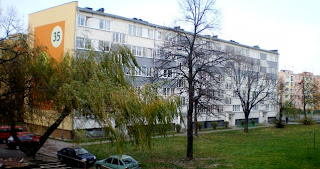 8. Tasmanians would probably want to have lifts in these buildings, which are expensive things to own and run (of course the benefit of having a lift is that the buildings can be up to ten stories)
The main advantages of building these apartments would include:
1. Reducing the cost of providing public housing. A large part of the cost of housing these days is the cost of land. Apartment blocks use less land, and the land which is used is put to better use
2. These places would be more environmentally friendly. Central heating is much more efficient than heating individual houses. Also the people living in these apartments will not need to use the car all the time
3. Greater security (certainly against arsonists). Neighbourhood watch would be able to work much better
But of course there will be people who will argue with a proposal such as this. Probably the loudest objections will be from people who want a three or four bedroom public housing house on a quarter acre of land. Of course they want it, who wouldn’t? But if they are desparate for accommodation, then they should be happy with what they are given. I have no doubt that private buyers would be more than happy to buy these apartments.
The current situation as I understand it is:
1. There is a shortage of rental properties in Tasmania
2. The rental properties that are available are overly expensive
3. Tasmania’s population recently exceeded 500,000 people
4. Housing affordability is very low
5. It is more difficult for people to get finance to purchase their own house
6. The federal government desires to spend big on public housing in order to keep the economy moving
7. There is a lack of new land available for the new housing which is required
Of course, because I am currently living in Poland, I do not have first-hand information about the situation. But I do have a different perspective. I am currently living in Jelenia Gora, an average sized city, in Poland. The population of Jelenia Gora is between 80 and 90 thousand people, so about half the size of Hobart. However it takes up about the same area as Kingston or Glenorchy. Most of the population lives in apartment blocks, and they are very happy about it.
We are living in a two bedroom apartment, which is one of sixty apartments in the block. The apartment block itself is five stories high and we live on the first floor. On our street there are about 40 such apartment blocks and I have no idea how many similar sized blocks are in the surrounding suburb. But anyway, the point is, that it is a lot more pleasant living here than I expected. There is ample room for the kids to play, our neighbours are polite, there doesn’t seem to be much crime around, the security system (although basic) works well…
And so I got to thinking: "Why couldn’t something like this work in Tasmania?"
I think that this could work quite well in Tassie, provided that the following requirements are met: 1. The apartments are positioned close (within walking distance) to shops and essential services such as public transport & schools
2. Ample car parking would need to be provided (it is not such an issue here, but Australians seem to need their cars)
3. At least half of the apartments should be sold to private owners. It is important from a cultural perspective that these places do not become a grotto for the unemployed (eg. Gagebrook)
4. The apartments should be built in desirable areas such as Taroona, Kingston, Clarence, South Hobart where there is already a positive culture. (Actually, the more I think about it, the best place to build these apartment blocks would be on the site of the existing Kingston High School)
5. The apartments should be heated centrally with ample insulation, including double glazed windows
6. There is ample space and facilities for children to play nearby
7. The outside of the buildings have an attractive appearance (not like this one)
 8. Tasmanians would probably want to have lifts in these buildings, which are expensive things to own and run (of course the benefit of having a lift is that the buildings can be up to ten stories)
The main advantages of building these apartments would include:
1. Reducing the cost of providing public housing. A large part of the cost of housing these days is the cost of land. Apartment blocks use less land, and the land which is used is put to better use
2. These places would be more environmentally friendly. Central heating is much more efficient than heating individual houses. Also the people living in these apartments will not need to use the car all the time
3. Greater security (certainly against arsonists). Neighbourhood watch would be able to work much better
But of course there will be people who will argue with a proposal such as this. Probably the loudest objections will be from people who want a three or four bedroom public housing house on a quarter acre of land. Of course they want it, who wouldn’t? But if they are desparate for accommodation, then they should be happy with what they are given. I have no doubt that private buyers would be more than happy to buy these apartments.
Subscribe to:
Posts (Atom)