Happy Easter everyone!
Have a great time!
Don't eat too much chocolate - it's bad for your teeth
Friday, 10 April 2009

Tuesday, 24 March 2009
Is there a line on the horizon or not?
I am a bit of a fan of U2 and I was really looking forward to their latest album - No Line on the Horizon (NLotH).
I must admit though, that even after listening to it for a week, I am unimpressed.
U2 is a band well known for changing their style and sounds, whilst still retaining their soul. Albums such as Rattle and Hum, Pop and All That You Can't Leave Behind have helped to define the current music scene. However albums such as Zooropa, How to Dismantle an Atomic Bomb (and now, dare I say it, NLotH) have not.
Perhaps U2's unpredictability has become too predictable? Perhaps Bono has lost his edge? Maybe Brian Eno wanted to get his moneys worth from his new echo machine? Maybe it's just that I have become out of touch? Who knows...
I guess that I have always enjoyed U2 for their clear lyrics (albeit difficult to understand) and strong guitar riffs. I've always thought that U2 was trying to say something (not necessarily something specific, although usually political or religious) through their music. It's as if the band knew what they wanted to say, and they used both words and music to convey their ideas and philosophies. ATYCLB was a classic example of this.
NLotH is definitely trying to say something, but it seems that the message is confused and hazy. It's more like U2 has stopped using a megaphone and is now transmitting via radio. A radio with poor connections and too much static. Has U2 become just another background noise?
Or maybe U2 is following the lead of REM. REM had a nice little album - Around the Sun, which was calm and introspective, and forgettable. Then REM released Accelerate, a more up-tempo album that returned to their rock roots. Is U2 returning to their rock roots with this album? I don't think so. In fact I don't know where U2 is going with this album...
(Of course it is also possible that I'm just annoyed because iTunes won't let me download the Cover Art...)
Saturday, 14 March 2009
Thoughts on public housing in Tasmania
In the past few months I have noticed the subject of public housing appear in the media. As a home owner in Tasmania, any news about the housing situation there is interesting to me.
The current situation as I understand it is:
1. There is a shortage of rental properties in Tasmania
2. The rental properties that are available are overly expensive
3. Tasmania’s population recently exceeded 500,000 people
4. Housing affordability is very low
5. It is more difficult for people to get finance to purchase their own house
6. The federal government desires to spend big on public housing in order to keep the economy moving
7. There is a lack of new land available for the new housing which is required
Of course, because I am currently living in Poland, I do not have first-hand information about the situation. But I do have a different perspective. I am currently living in Jelenia Gora, an average sized city, in Poland. The population of Jelenia Gora is between 80 and 90 thousand people, so about half the size of Hobart. However it takes up about the same area as Kingston or Glenorchy. Most of the population lives in apartment blocks, and they are very happy about it.
We are living in a two bedroom apartment, which is one of sixty apartments in the block. The apartment block itself is five stories high and we live on the first floor. On our street there are about 40 such apartment blocks and I have no idea how many similar sized blocks are in the surrounding suburb. But anyway, the point is, that it is a lot more pleasant living here than I expected. There is ample room for the kids to play, our neighbours are polite, there doesn’t seem to be much crime around, the security system (although basic) works well…
And so I got to thinking: "Why couldn’t something like this work in Tasmania?"
I think that this could work quite well in Tassie, provided that the following requirements are met: 1. The apartments are positioned close (within walking distance) to shops and essential services such as public transport & schools
2. Ample car parking would need to be provided (it is not such an issue here, but Australians seem to need their cars)
3. At least half of the apartments should be sold to private owners. It is important from a cultural perspective that these places do not become a grotto for the unemployed (eg. Gagebrook)
4. The apartments should be built in desirable areas such as Taroona, Kingston, Clarence, South Hobart where there is already a positive culture. (Actually, the more I think about it, the best place to build these apartment blocks would be on the site of the existing Kingston High School)
5. The apartments should be heated centrally with ample insulation, including double glazed windows
6. There is ample space and facilities for children to play nearby
7. The outside of the buildings have an attractive appearance (not like this one)
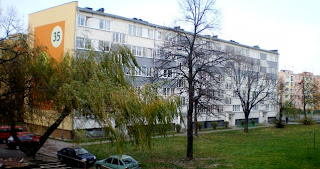 8. Tasmanians would probably want to have lifts in these buildings, which are expensive things to own and run (of course the benefit of having a lift is that the buildings can be up to ten stories)
The main advantages of building these apartments would include:
1. Reducing the cost of providing public housing. A large part of the cost of housing these days is the cost of land. Apartment blocks use less land, and the land which is used is put to better use
2. These places would be more environmentally friendly. Central heating is much more efficient than heating individual houses. Also the people living in these apartments will not need to use the car all the time
3. Greater security (certainly against arsonists). Neighbourhood watch would be able to work much better
But of course there will be people who will argue with a proposal such as this. Probably the loudest objections will be from people who want a three or four bedroom public housing house on a quarter acre of land. Of course they want it, who wouldn’t? But if they are desparate for accommodation, then they should be happy with what they are given. I have no doubt that private buyers would be more than happy to buy these apartments.
The current situation as I understand it is:
1. There is a shortage of rental properties in Tasmania
2. The rental properties that are available are overly expensive
3. Tasmania’s population recently exceeded 500,000 people
4. Housing affordability is very low
5. It is more difficult for people to get finance to purchase their own house
6. The federal government desires to spend big on public housing in order to keep the economy moving
7. There is a lack of new land available for the new housing which is required
Of course, because I am currently living in Poland, I do not have first-hand information about the situation. But I do have a different perspective. I am currently living in Jelenia Gora, an average sized city, in Poland. The population of Jelenia Gora is between 80 and 90 thousand people, so about half the size of Hobart. However it takes up about the same area as Kingston or Glenorchy. Most of the population lives in apartment blocks, and they are very happy about it.
We are living in a two bedroom apartment, which is one of sixty apartments in the block. The apartment block itself is five stories high and we live on the first floor. On our street there are about 40 such apartment blocks and I have no idea how many similar sized blocks are in the surrounding suburb. But anyway, the point is, that it is a lot more pleasant living here than I expected. There is ample room for the kids to play, our neighbours are polite, there doesn’t seem to be much crime around, the security system (although basic) works well…
And so I got to thinking: "Why couldn’t something like this work in Tasmania?"
I think that this could work quite well in Tassie, provided that the following requirements are met: 1. The apartments are positioned close (within walking distance) to shops and essential services such as public transport & schools
2. Ample car parking would need to be provided (it is not such an issue here, but Australians seem to need their cars)
3. At least half of the apartments should be sold to private owners. It is important from a cultural perspective that these places do not become a grotto for the unemployed (eg. Gagebrook)
4. The apartments should be built in desirable areas such as Taroona, Kingston, Clarence, South Hobart where there is already a positive culture. (Actually, the more I think about it, the best place to build these apartment blocks would be on the site of the existing Kingston High School)
5. The apartments should be heated centrally with ample insulation, including double glazed windows
6. There is ample space and facilities for children to play nearby
7. The outside of the buildings have an attractive appearance (not like this one)
 8. Tasmanians would probably want to have lifts in these buildings, which are expensive things to own and run (of course the benefit of having a lift is that the buildings can be up to ten stories)
The main advantages of building these apartments would include:
1. Reducing the cost of providing public housing. A large part of the cost of housing these days is the cost of land. Apartment blocks use less land, and the land which is used is put to better use
2. These places would be more environmentally friendly. Central heating is much more efficient than heating individual houses. Also the people living in these apartments will not need to use the car all the time
3. Greater security (certainly against arsonists). Neighbourhood watch would be able to work much better
But of course there will be people who will argue with a proposal such as this. Probably the loudest objections will be from people who want a three or four bedroom public housing house on a quarter acre of land. Of course they want it, who wouldn’t? But if they are desparate for accommodation, then they should be happy with what they are given. I have no doubt that private buyers would be more than happy to buy these apartments.
Tuesday, 3 February 2009
Is it time for a New World Order?
Recently there was an article in the Sydney Morning Herald claiming that our good friend Kevin Rudd believes that now is the time for a New World Order in the financial sector.
Is this merely political posturing, or is it part of a more sinister plan? Who knows?
My current experience suggests that a lot of people are worried mostly because they don't understand what is going on. So I will do my best to give my understanding and views of how this so-called world wide crisis appeared.
Basically most people in the Western world (USA, Europe, Australia) have enjoyed steady growth in their economies for quite a long time now. For example very few people will have clear memories of Keating's 'Recession we had to have,' and the Asian crisis in 1997 didn't affect many people outside of Asia. Some people (not just economists) were so proud of the long spate of steady growth that they claimed that the business cycle was dead.
So, here is my view of things (taken from an Australian perspective). I have tried to make it as simple as possible:
1. Australia's rate of economic growth over the past ten years has come primarily from rising commodity prices, which rose primarily due to the growth of the economy in China. Resource companies, such as mines, made a lot of money which invariably flowed through to the rest of the economy.
2. China's growth has come primarily from exports to the US
3. The US demand for exports was based on the rise of US household debt. People were basically increasing their mortgages in order to buy consumer goods (eg. cars, TV's, computers etc). A similar thing was happening in Australia, but to a lesser extent.
4. Banks in the US lent too much money (because they were greedy) and had rather relaxed lending requirements. This was fine as long as house prices kept rising and peoples wages kept improving in order to cover their interest repayments.
4a. US banks packaged up and sold their high risk loans to other international banks and financial institutions.
5. By the beginning of 2008, some house prices in the US started to fall and there was a rising number of foreclosures where people couldn't pay their mortgages. Foreclosures are very bad for banks, because not only do they lose the interest repayments (income), if they cannot sell the house at market value (which is very often the case) then they lose significantly more as well. This is why banks started posting losses of up to 10 times the profits they were posting a couple of years ago.
6. Because of the extraordinary large losses being made by US Banks (causing a number to go bankrupt in the space of less than a year), other banks (including banks in foreign markets) became scared to lend to each other, making it harder for banks to get money to on-lend to it's customers.
7. Because banks no longer had easy access to finance, they tightened the lending restrictions, making it difficult for businesses and people to borrow money (for example in Italy it became so hard for businesses to borrow money, many have to borrow money from the Mafia). And because businesses no longer had access to finance, they could not expand as easily or they had cash flow problems, causing them to lay-off staff.
8. All of a sudden people have become afraid of their jobs, which means that they are no longer confident enough to buy a new car, buy new electronic items (eg stereos, TV's); and even if they wanted to, they would have difficulties getting finance. This has caused thousands of people to be fired from places such as Panasonic, Sony and has caused a significant amount of problems for car-makers all around the world (especially those in the US).
9. This drop in consumer demand has meant that people are buying less exports. Therefore China (whose growth has largely come from exports) is no longer growing as fast as it did. Therefore they are no longer buying as many resources as they did, causing commodity prices to drop. Causing problems for Australian resource companies who (as mentioned in point 1) were one of the keys to Australia's growth over the last ten years.
Well. That was a bit longer than I hoped, sorry that haven't explained anything in full. I guess it just proves how complicated everything is at the moment. In particular I have not referred to interest rates, oil prices, the food crisis or exchange rates (because these are just another level of complexity).
Nothing that has happened over the past six to twelve months was unforeseeable. People have simply been ignoring the signs. That is: rising debt levels, China's dependence on the US, instability in the share market, etc...
But is it time for a new world order? Probably not, it's just time for everyone (especially those in the West) to reduce their reliance on debt and to stop living beyond their means. (sounds a bit like hedonism, I know)
You'll have to come up with your own conclusions.
Is this merely political posturing, or is it part of a more sinister plan? Who knows?
My current experience suggests that a lot of people are worried mostly because they don't understand what is going on. So I will do my best to give my understanding and views of how this so-called world wide crisis appeared.
Basically most people in the Western world (USA, Europe, Australia) have enjoyed steady growth in their economies for quite a long time now. For example very few people will have clear memories of Keating's 'Recession we had to have,' and the Asian crisis in 1997 didn't affect many people outside of Asia. Some people (not just economists) were so proud of the long spate of steady growth that they claimed that the business cycle was dead.
So, here is my view of things (taken from an Australian perspective). I have tried to make it as simple as possible:
1. Australia's rate of economic growth over the past ten years has come primarily from rising commodity prices, which rose primarily due to the growth of the economy in China. Resource companies, such as mines, made a lot of money which invariably flowed through to the rest of the economy.
2. China's growth has come primarily from exports to the US
3. The US demand for exports was based on the rise of US household debt. People were basically increasing their mortgages in order to buy consumer goods (eg. cars, TV's, computers etc). A similar thing was happening in Australia, but to a lesser extent.
4. Banks in the US lent too much money (because they were greedy) and had rather relaxed lending requirements. This was fine as long as house prices kept rising and peoples wages kept improving in order to cover their interest repayments.
4a. US banks packaged up and sold their high risk loans to other international banks and financial institutions.
5. By the beginning of 2008, some house prices in the US started to fall and there was a rising number of foreclosures where people couldn't pay their mortgages. Foreclosures are very bad for banks, because not only do they lose the interest repayments (income), if they cannot sell the house at market value (which is very often the case) then they lose significantly more as well. This is why banks started posting losses of up to 10 times the profits they were posting a couple of years ago.
6. Because of the extraordinary large losses being made by US Banks (causing a number to go bankrupt in the space of less than a year), other banks (including banks in foreign markets) became scared to lend to each other, making it harder for banks to get money to on-lend to it's customers.
7. Because banks no longer had easy access to finance, they tightened the lending restrictions, making it difficult for businesses and people to borrow money (for example in Italy it became so hard for businesses to borrow money, many have to borrow money from the Mafia). And because businesses no longer had access to finance, they could not expand as easily or they had cash flow problems, causing them to lay-off staff.
8. All of a sudden people have become afraid of their jobs, which means that they are no longer confident enough to buy a new car, buy new electronic items (eg stereos, TV's); and even if they wanted to, they would have difficulties getting finance. This has caused thousands of people to be fired from places such as Panasonic, Sony and has caused a significant amount of problems for car-makers all around the world (especially those in the US).
9. This drop in consumer demand has meant that people are buying less exports. Therefore China (whose growth has largely come from exports) is no longer growing as fast as it did. Therefore they are no longer buying as many resources as they did, causing commodity prices to drop. Causing problems for Australian resource companies who (as mentioned in point 1) were one of the keys to Australia's growth over the last ten years.
Well. That was a bit longer than I hoped, sorry that haven't explained anything in full. I guess it just proves how complicated everything is at the moment. In particular I have not referred to interest rates, oil prices, the food crisis or exchange rates (because these are just another level of complexity).
Nothing that has happened over the past six to twelve months was unforeseeable. People have simply been ignoring the signs. That is: rising debt levels, China's dependence on the US, instability in the share market, etc...
But is it time for a new world order? Probably not, it's just time for everyone (especially those in the West) to reduce their reliance on debt and to stop living beyond their means. (sounds a bit like hedonism, I know)
You'll have to come up with your own conclusions.
Subscribe to:
Comments (Atom)